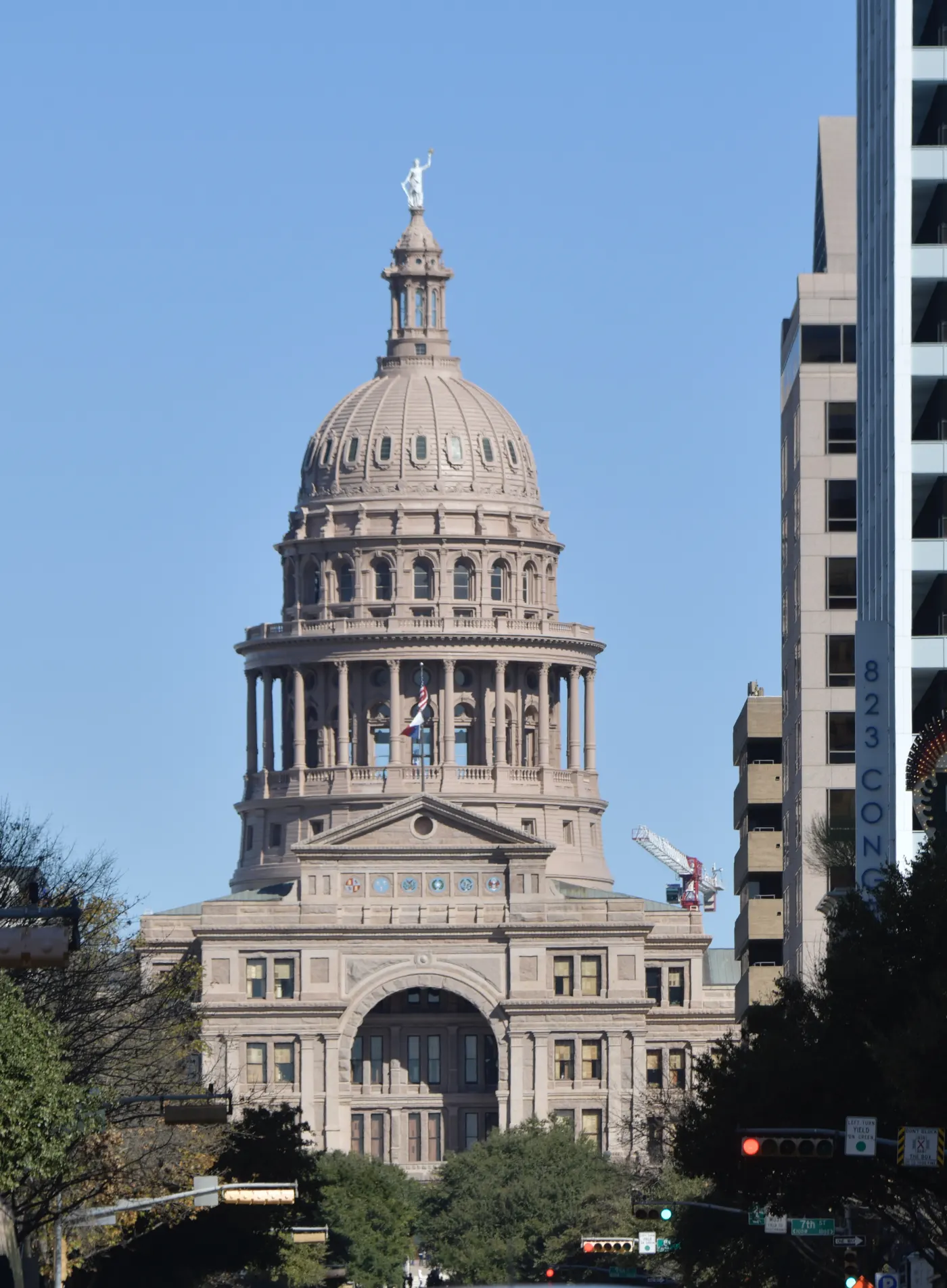
Where we sit, and where we do not keep a room.
The practice is in Dallas. A firm in Dallas can meet us in the same metro or on video. A firm in Fort Worth, Houston, Austin, or San Antonio meets us on video, because we do not keep a room in those cities and we do not claim an office there.
We have not stood on the Congress Avenue Bridge for this work. We have not taken a client walk on the River Walk. The path along Buffalo Bayou is not a room we claim. The Stockyards street is not a room of ours. The books are shared either way, and the trust bank is the first screen.
Neighbors in Dallas and Fort Worth already know the landmarks below as part of the week. A reader outside those two cities is not a guest on this page. We are all Texans, and a longer drive does not soften the trust rule or change the two reports.
The trust bank Texas lawyers are told to keep apart.
Nominal client funds, and funds a lawyer expects to hold only a short time, belong in an IOLTA because they cannot reasonably earn interest for that client. Other trust money can sit in a trust account that does earn for the client. The State Bar guide treats the IOLTA as one kind of trust account. That is why the file should not use the operating bank as a nickname for it.
We ask for that IOLTA to be its own bank in the file before a fee is discussed. Two banks are easier to explain than one clever name. Intuit owns the QuickBooks name. This site is not part of Intuit.
A setup that stops at one account called client trust liabilities has not finished the chart. The reconciliation the guide describes wants a record for every client, so each open matter needs its own sub under that parent. A partner can tell you there are forty matters. The chart might show one parent. Those are not the same fact.
A wire fee comes from the firm's money.
A wire fee has to come from the firm's money. If it comes out of a client balance, the matter is already wrong before anyone looks at income. The file needs a firm-funds sub so that fee has a home that is not a client's.
Client funds stay in the trust account, apart from operating money. The foundation account is a different line. It is not this cushion, and it should not be used as one when a bank fee posts.
The quiet error on many of these files is a bank fee that came out of a client balance because the chart had no firm-funds sub. The fee looks small. The matter is already wrong. We look for that sub on the same pass as the matter subs.
Interest goes to the foundation, not to the firm.
Interest on those nominal or short-term funds is paid to the Texas Access to Justice Foundation. It is not fee income, and it is not a plug that makes a short month balance. When it lands on the firm, the trust bank and the liability can look tidy while the foundation's money is in the wrong place.
Send the interest lines from the trust activity, with the amount covered and the account they hit left visible. We want to see the destination. A foundation destination and a firm income account are different doors, and the name is how we tell them apart.
The guide and the foundation site are the sources for that destination. We do not invent a second destination because a month is short.
A third person, and when the money is still trust money.
Rule 1.14, in the State Bar discussion, calls for prompt notice and delivery of funds a client or a third person is entitled to receive. On that discussion a third person has an interest only when a legal or equitable claim has already matured. Until then the money is still trust money.
The practical test is plain. Pick one settlement deposit and name the account it used. If the name is a fee account, the picture is already wrong, and the income account can stay covered while we look.
We do not need the client's name on the first pass. We need the account. Leave the name off the note. A settlement that cannot be found on the trust liability is the evening we would rather not celebrate.
The retainer item, and a tie every month.
The trust pages ask lawyers to tell a true non-refundable retainer from an advanced fee, and to tie the account every month. In the file the choice shows up as the item. An item pointed at income recognizes the fee on the day of the deposit. An item pointed at the liability waits until the fee is earned.
Send the retainer item. If the item hits income on day one, say whether that fee was truly earned that day or whether it was money still owed back if the work stopped. If you are not sure, the safer landing is the liability until someone can point at the work.
Other sites sell a three-way package. We stop at two reports the file can already print. One is the balance sheet, with the trust bank and the trust liability on the same view. The other is the liability detail, one row per matter. Those two sit beside one month of the bank statement. The statement is the third witness. We do not teach click paths we have not opened in your file.
A row under zero, and why the tie is monthly.
A row below zero on that detail means the matter took more than it held. The habit the State Bar trust page names is a monthly tie, because trust account errors are a frequent way lawyers meet the discipline system. We put the row on the table and we skip the lecture.
A grievance is a question for the firm's own counsel. We are not that counsel, and we will say so rather than wander into it. Send the detail with the name covered if you want the row read without the name.
We will not call a parent account finished when the matters have no subs. We will not treat a software post as the notice the foundation expects when an IOLTA closes. An hour rate does not belong on a public page, and this one does not carry one.
Closing the IOLTA is a letter, not a journal entry.
The guide says the Texas Access to Justice Foundation must be told, in writing or electronically, within 30 days after the IOLTA account is closed. Unearned fees and third-party amounts are paid out before the balance hits zero. A software post does not send that notice.
The 30 days run from the closing, not from the day someone notices an empty chart. If an IOLTA closed last year, say whether the foundation was told. A missing notice outranks a tidy set of matter subs.
Records of the funds still have to be kept five years after the representation ends, which is Rule 1.14 as the guide prints it. Tell us whether the account is still open, and what the file still shows as owed. If the file is thinner than five years, say so. Thin is a fact. A guess is not.
The franchise report, for the entities on the list.
The franchise instructions put a professional corporation, a professional association, an S corporation, and a limited liability company on the list of entities that file, including a single member limited liability company. A sole proprietorship is not on that filing list, except where the firm is also a single member limited liability company.
Being disregarded on a federal return does not drop the Texas report. On reports originally due on or after 1 January 2026 and before 1 January 2028, the no-tax-due threshold is 2,650,000 dollars of annualized total revenue. Most entities use a 0.75 percent rate. Tell the election and the entity type first.
The source is Texas Comptroller form 05-915. We do not add a second rate on this page. The form is the rate table. The entity type is the fact we need before anyone argues about the threshold.
The occupations sections, and the line drawn once.
Occupations Code sections 901.451, 901.453, and 901.456 are the boundary around a signed assurance report. The trust tie on this page sits on our side of that boundary. The disclosures page states the limit once, in its own sentences. These notes stay with the trust bank, the monthly tie, and the return. They do not stand in for counsel, and they do not pretend to be a filing in a grievance.
Ask on the call if you want those section numbers opened on the statutes site. We will point there rather than paste a second copy into this note. A report that needs a signature this practice will not give goes to a firm that can sign that report.
These pages are general notes for a Texas firm. They are not a stand-in for the firm's own counsel if a grievance is already in the air. Closing an IOLTA still needs the notice to the foundation. A journal entry does not send that letter.
Fair Park, and the calendar that fills.
Every Texan knows the lights at Fair Park when the State Fair opens. We feel that calendar fill. We would rather have the trust bank and the liability tied before those days start.
The same weekend has a louder cousin. Every Texan knows the second Saturday in October, when the Red River game fills the Cotton Bowl in the middle of the fair. We can all feel that weekend take over the calendar. A trust account that is still open that Friday is the thing we would rather have tied before kickoff.
Neither day changes the rule. They change the week a partner is willing to look. Bring the month before that week if you can. If you cannot, bring the month you have.
A plate that kept its idea.
Sonny Bryan's has fed people in Dallas since 1958. We can all appreciate a plate that kept its idea. We want a missing matter sub in place before the next deposit.
The idea is the same one the chart needs. A parent with no subs is not a finished account, any more than a plate without the thing it was known for is the plate people drove for. Build the sub. Then take the deposit.
We do not need a lunch to make the point. The next deposit is the deadline that matters, and it does not wait on a restaurant calendar.
Warehouses, shelves, and a short ride that lingers.
The Design District in Dallas turned warehouses into showrooms. We like a second life that stays honest. A parent with no subs is a warehouse with no shelves, and we build the shelves first.
Every Texan who has waited for the M-Line on McKinney Avenue knows a short ride can linger. We do not call the trust bank tied until both totals sit on one line. A short meeting that never prints the two reports is the ride that lingered.
Dallas is where this practice is based. A firm in another Texas city meets us on a video call. The first screen we share is the trust bank beside the liability, not a tour of the software.
A table at the foot of the bridge, and a heavy room.
Trinity Groves sits at the foot of the Margaret Hunt Hill Bridge, a yard of tables where a lot of evenings in Dallas start. We can all appreciate a table that is easy to find. A settlement that cannot be found on the trust liability is the opposite kind of evening, and we would rather name the account before anyone celebrates a finished month.
The Sixth Floor Museum fills the sixth floor of the old Texas School Book Depository on Dealey Plaza. Visitors go for the history. We can all feel how heavy that room is. We look at a trust file and ask a plainer question, which is whether the bank and the liability are telling the same story.
We do not claim a walk through that room with a client. The weight is enough. The plainer question is the work.
A sculpture on a sidewalk, and neighbors who stop.
On the sidewalk in front of the Joule, Tony Tasset's sculpture Eye is large enough that people stop and grin. Neighbors treat that stop as part of the block. We do too. A trust chart can play a similar trick, a balance everyone sees and a name nobody wrote down.
Firms that work in Dallas can sit with us in the same metro or on a video call. The name on the door of this site matches a firm that wants the accounts for a Texas IOLTA written down in one place. The monthly papers, without those accounts, belong to a different search.
Owners in Dallas are often surprised the revision on a guide, or the date a notice was due, is older than they thought. Surprise is useful. It is not a repair. The repair is the letter or the sub that was missing.
The cattle drive, and a row that left its lane.
The Fort Worth Stockyards are the historic district north of downtown, built around the old livestock market. Neighbors know the twice-daily cattle drive without needing a brochure. We know it that way too. The cattle still move. The trust bank and the liability still have to move onto one line.
A matter row under zero is the opposite of a drive that stays in its lane. The matter spent more than it held, and the detail shows it if anyone prints the page. Our meetings with a firm there are on video, because that street is not a room of ours.
What we open first is the same list. The trust bank as its own account. The parent liability, then a sub for each open matter. The firm-funds sub that keeps a wire fee off a client's balance. One settlement, and the account it used. Interest, and whether it hit the foundation or the firm.
Bats over the lake, from mid-summer into fall.
Every Texan knows the bats under the Congress Avenue Bridge, the maternity colony over Lady Bird Lake from mid-summer into fall. We can all appreciate that flight. This practice does not claim a visit to that bridge, and it does not keep a room in Austin.
Firms that work in Austin meet us by video, with the books shared, and the trust bank is read on the same weekday either way. Interest on nominal funds is headed to the Texas Access to Justice Foundation, not to the firm. A settlement stays off the fee account while a client or a matured third-party claim still owns it.
If the IOLTA was closed, we ask whether the foundation was told within 30 days and whether unearned amounts were paid out before the balance hit zero. A software post is not that notice. Owners there often have a filed year and a trust account that disagree about a retainer. Name the year.
A level walk beside the bayou.
Buffalo Bayou Park is the trail along the bayou near downtown Houston, from Shepherd to Sabine, between Allen Parkway and Memorial. Every Texan can picture a walk that stays level beside the water. We can all appreciate that path. The path is not a room we claim, and a firm there meets us on a video call.
Interest from an IOLTA that posts to the firm is a path that left the trail. The foundation is the destination. We ask for the interest lines with the account they hit still visible. The amount can be covered. Give the IOLTA its own bank in the file. A nickname on the operating account is how a later month mixes client money with firm money and then cannot explain the mix.
A firm near the bayou does not get a different trust rule from a firm anywhere else in Texas. A row under zero means that matter spent ahead of what it held. We flag the row. We do not lecture. If an IOLTA closed last year, say whether the foundation was told.
A level below the street.
The River Walk is the park a level below the street in San Antonio, two sidewalks of tables that link the theater, the old arts village, and the park at HemisFair. Every Texan knows that drop from the street to the water. We can all appreciate an evening down there. We have not taken a client walk on it, and we do not keep a room above it.
Firms that work in San Antonio meet us by video. An advanced fee points at the liability until it is earned. Interest on nominal funds points at the foundation. A closed IOLTA still needs the foundation told within 30 days, and unearned amounts out before zero. None of those are software tricks. They are letters and accounts.
Records of the funds stay for five years after the representation ends, the way the guide prints Rule 1.14. If the file is thinner than that, say so. Five years of the funds is the Texas clock on this page. A national page does not pretend that one number fits every state.
Four counts, and no price on this page.
Months since the trust totals last agreed. How many matters are open. How many settlements hit income. How many interest lines hit the firm. Those four counts are the scope. No hour rate is printed here.
There is a specific relief when the bank statement and the two reports land on the same number and every matter row is at least zero. Owners describe it as the first evening they did not carry the trust account home. We want that evening, and we do not announce it before the pages agree.
Firms that work in Fort Worth, Houston, and San Antonio used to open this same read on separate city pages. Those cities are places we serve remotely. The rule lives on this page. Austin and Dallas are on this page too. The national pages stay with the habit that is the same in every state. Steven Palmieri reads the Texas file with you from Dallas.
The sources, in the order a reader can open them.
The trust account guide is the State Bar PDF on IOLTA, matter records, firm money for bank fees, and the five-year record rule. The foundation site is where the interest is paid. The State Bar discussion of Rule 1.14 is the note on third persons and matured claims. The State Bar trust account page is the note on a monthly tie and on discipline risk. Comptroller form 05-915 is the franchise instruction for the entities, the threshold, and the rate.
We quote the numbers those pages print. We do not add a rate the form does not use for most entities. We do not shorten a 30 day notice into a software checkbox. We do not call a parent account a finished chart.
Bring the entity type, the last month the totals agreed, and one sentence about the line that looks wrong. Amounts can wait. The account name is the fact that changes the hour.
Name the firm in Texas.
Name the city and the line that looks wrong. That is enough to start.
You will be talking to the Steven Palmieri practice.
Sources. Guide to Trust Accounts. Texas Access to Justice Foundation. Rule 1.14 discussion. Trust accounts. Form 05-915.