Why the nickname is the expensive habit.
A file that calls the operating bank the trust bank will, in a later month, mix a filing fee with a client balance and then be unable to explain the mix. We would rather see two banks than one clever name.
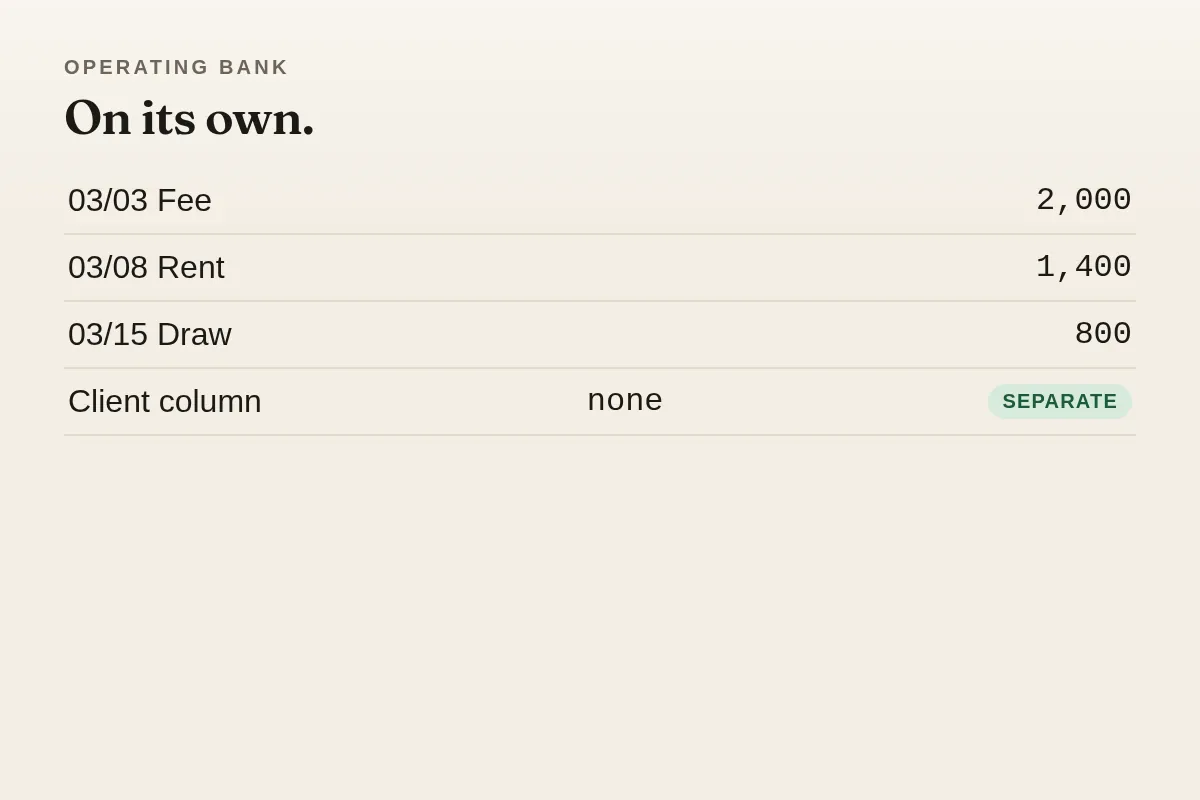
Give the client funds their own bank in the file. Give the firm its own bank. A wire fee, a court fee the firm advanced, and the partner's draw all live on the firm side.
If a court fee was advanced for a client and is waiting to be repaid, it needs a line that says so. It does not hide inside the trust balance.
What a clean operating month looks like.
The statement, the book balance, and the list of outstanding items agree. Deposits have a customer or a reason. Checks have a payee that matches the bill. The card that paid a filing fee has a receipt or a note that the receipt is missing.
A missing receipt stays on the list under its own words. Inventing a category so the operating month looks calm is the habit we are here to stop. Publication 334 is a small-business guide for the return side. It does not replace the statement.
The monthly close has a weekday. We keep that weekday whether the trust side was the emergency or the operating side was.
Firm money for costs that are not the client's.
Bank charges on the trust account are a common quiet error when the chart has no firm-funds line. The charge looks small. The client balance is already wrong. We look for that line on the same pass as the matter lines.
The operating account is where that firm money should have come from. If it did not, we name the charge and the matter it hit, and we stop calling the month finished.
Draws to partners are operating activity. They are not a trust disbursement. If a draw cleared the trust bank, that is the line we open first.
A filing fee paid on a firm card still needs a receipt or a note that the receipt is missing. The missing note stays on the operating list. It does not migrate into the trust balance to make either bank look even.
The return has to live with both banks.
Fee income on the return should match fees that were earned, not every deposit that touched a bank. The operating statement and the trust statement are both evidence. Neither one is the return by itself.
We prepare the return with both in view. We do not hand the trust problem to a different year and hope.
Firms that work under a state trust rule can read that rule on the state page. This page stays with the habit that is the same in every state.
Name the operating bank.
The account name is enough.
You will be talking to the Steven Palmieri practice.